


What are the differences between mixed-flow pumps and centrifugal pumps? Introduction to the working principle of mixed-flow pumps
2022-09-30
Mixed-flow pumps are high-specific-speed pumps widely used in agricultural irrigation, flood control, wastewater treatment, power plant cooling systems, and other fields. Axial flow pumps, in high-flow, low-head applications, exhibit small variations in head and flow rate and poor cavitation resistance. Replacing axial flow pumps with mixed-flow pumps leverages the advantages of axial flow pumps while largely mitigating these shortcomings, resulting in improved application performance.
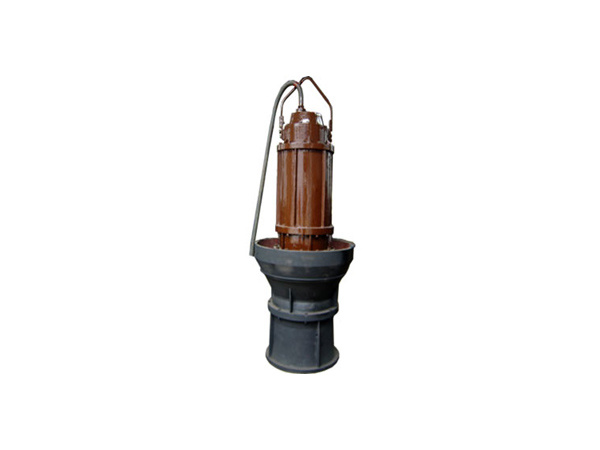
A mixed-flow pump is a device used for liquid transportation. Do you know how a mixed-flow pump works? It differs from centrifugal pumps and axial flow pumps, which also transport liquids. Let's explain this based on the above question.
Working principle of a mixed-flow pump: A mixed-flow pump consists of a pump body, pump cover, impeller, pump shaft, bearing box, and stuffing box. It is a device that transports liquids by relying on a combined action of centrifugal force and the rotating shaft. During operation, when the prime mover drives the blades to rotate, it generates a combined force of centrifugal force and axial thrust on the liquid inside the machine. Water is sucked in and flows out at a certain angle to the impeller axis along the flow direction of the mixed-flow pump, hence it is also called a diagonal flow pump. It is a pump similar to centrifugal pumps and axial flow pumps. During operation, the general speed is between 300 and 500. Based on the working characteristics of the mixed-flow pump, it is generally used for irrigation in plain lake areas, urban drainage, and circulating water pumps in hot areas.
Mixed-flow pumps are a product of centrifugal pumps and axial flow pumps, but there are still significant differences in terms of use, working methods and principles, performance, and structure. Let's explain this based on the differences between the two.
1. Different directions of liquid entry into the blades: Mixed-flow pump: the axial and radial directions form an angle with the center of rotation of the impeller; Centrifugal pump: same as the centrifugal force direction; Axial flow pump: the liquid maintains axial flow, parallel to the blade center. 2. Difference in speed: Centrifugal pump around 300, axial flow pump above 500, mixed-flow pump between the two, between 300-500. 3. Different working principles: Centrifugal pump directly transports liquid through the centrifugal force generated by the rotation of the blades; Axial flow pump transports liquid using the lift generated by the rotating blades; Mixed-flow pump is a combination of centrifugal and axial flow pumps. When the blades rotate, the lift and centrifugal force generated by the blade rotation act simultaneously to transport the liquid. 4. Performance differences among the three: The performance curve shape of the mixed-flow pump is also between that of a balanced centrifugal pump and an axial flow pump. The relationship and change law between the flow rate, head, and power of a high-head mixed-flow pump are close to those of a centrifugal pump, while those of a low-head mixed-flow pump are close to those of an axial flow pump. In use, mixed-flow pumps should not be started with a closed valve but should be started directly with an open valve. This not only reduces the power during startup but also protects the engine from burning.
Related information

Mobile:
Telephone:
Tel: Liu Fengxing13951151198 / 0523-88301008
E-mail:1911306499@qq.com
Address: Jiangdu Town Industrial Concentration Zone, Jiangyan City, Jiangsu Province
HUATAO GROUP
Leave a message online to get a free application solution
Copyright © 2025 Jiangsu Jiangjin Pump Industry Co., Ltd.